Pages

Showing posts with label paper. Show all posts

Thursday, September 1, 2011

Haunted Hats

These sweet-creepy hats have been a joy to create. Made of Strathmore Art Again black paper, they are tediously decorated with spiderweb sequins, vintage thrift shop tulle, pipe cleaner, tiny poms, jewels, ribbons and cord. The feathers, flowers, spiders and bats are all paper, detailed with iridescent paints, (Jo Sonja). Enjoying my work means slowing down, having fun and accepting a challenge. Cone-shaped hat, I tamed thee.
The cone is tricky, especially with the stiff paper these hats require. I use a paintbrush handle and a bone folder to break the grain of the black card stock. It takes a few repetitions to curl into a cone shape. The cone has to be held in place while the glue sets. Though the paper is conditioned, it takes patience to keep everything in line. After five hats, I use a tiny clothespin to secure the base of the cone. This helps a lot.
I am proud of that big spider on this finished hat. Mag is a 1/3 scale doll and it fits her as a dramatic over-sized hat. She wears it well. Look closely and you can see her eyes are a little unsettling. This hat was designed to be a "fascinator" for a real person. It has two loops on the inside to attach barrettes or hairpins. A fascinator is a miniature hat or embellishment that does not cover the entire head.
Aaaaahhhhh! Infestation! I love these spiders, but they scare the heck out of me when they venture off on their own. And they do. Those little legs stick on my clothes and end up in the strangest of places. I said I would keep track this time - but the spiders think otherwise.

Monday, June 13, 2011

Paper Houses

It looks like someone is having a garage sale or a fight. The disarray makes me giggle. This photo shows the collection of miniature furniture that has built up over the weekend. Each item is cut many times until it is easy to fold and glue.


See the wagon? It has striped wheels. This is my adaption of Mr. Cloud's free toy.


The little table on the right needs more work. In this scale, the tabs have disappeared. Make them too large and they overlap the space in the legs. Most of these tabs are kept in place with the tip of an x-acto knife while the glue sets.


Note: The Aileen's Tacky Glue Pen, which I reviewed earlier this year, proves to be invaluable for this kind of work. As I have used the pen, the glue has thickened slightly and does dry quickly. The fine tip lays down the tiniest glue line or dot. The cap is easy to keep track of. The precision is complimented by the pen-style application.


Ah yes, simpler times, before the neighborhood got over run-(Friday). Here are two houses in different scales. The bed is still not small enough to go in the green house. It may end up as a playhouse or something. All of these houses began with the cottage lantern from my book, Silhouette Style. I changed the peak, the windows and added a floor and moldings for the windows. I discovered a setting on my Klic-n-Kut cutter that makes these adorable pounce (fold) lines in an appropriate size. The folds are crisp.


The bed is one piece with a bedspread and pillow. The pillow is a miniature version of the one in my book. The pillow puffs up just like the big ones. I glued the pillow in place. The hardest part of working in this scale is holding on to the pieces. I lost a spade one night and didn't find it until I felt something odd on the sleeve of my shirt. If they hit the floor, they're finished.


The divan! This gives you perspective on size. The houses include a set of furniture. The doors open and close. There is a butterfly from another project sticking out from under a layer of scrap paper. It builds up to a certain point beneath my work lamp, gets excavated and goes into the vault of the shoebox.


Sunday, June 12, 2011

Inspiration: C. Carey Cloud

The Cracker Jack prize was always exciting to me. The miniature mystery in the little thin paper package brought me joy, just like millions of other kids. From the 1930's through the 1960's, C. Carey Cloud designed, created and delivered 700 million toys to the Cracker Jack company.


His other clients included Pillsbury, Brach's Candy, CoCo Wheats and more. He designed toys; paper toys, plastic toys, moving toys, theme toys. Many of the paper toys use simple mechanisms to make them move or jump. Above is one of his "action toys". Look at all the details in this pirate. Do you think you could have a kid's toy pirate sitting on a keg of rum today? Probably not. Maybe he would have had to remove the X's.

His lines are simple and convey a complete vignette with subtle, but complete detail. Notice the soft scales on the fish, the sweep of lines on the fins, the sketch of a coral. You could get an assortment of 20 for $1.00 by mail order. Mr. Cloud inspecting a batch of plastic figures. He sculpted much larger than the final size. He had an endless imagination and the skills of several men. He was called the "Year-'Round Santa Claus" and it is easy to see why. His toys had a sophistication to them. It seemed there was a lot of child in his spirit.


Here is a punch-out for a wagon. It is perforated in two places and folds up to look like the mini drawing on the background. His instructions are easy, concise and complete.

Can you believe tin prizes? This is only one in a series of toys for Cracker Jack made from lithographed tin. Carey Cloud found that the Ball Brothers, of canning jar fame, had tons of scrap tin from lids selling for $25 a ton. He was able to produce over 80 million toys before the Ball Brothers found out what he was doing and raised the price to $125 a ton. That was the end of the metal toys in Cracker Jacks.


C. CAREY CLOUD - Google him to learn more.


Friday, October 22, 2010

Paper: Cyan Haunted House Vignette

Haunted House: Paper, tea lights, feather boa, fake spider web


This haunted house photo has been saturated with blue, resembling a cyanoprint. Checking on a cyan fact, I ran across some spooky information on the color

CYAN:

Cyanoprint - a technique of photography developed about 160 years ago that used a mixture of chemicals including Prussian Blue pigment and no silver.

Prussian Blue was one of the first synthetic pigments and is called: Parisian Blue, Berlin Blue and Cyan. From Prussian Blue was derived Prussic Acid and ferrocyanide, (meaning a blue substance with iron in it).
It is used in photography, blueprints, paint and inks.

On an electronic display device, it is called Electric Cyan. Printing ink is Process Cyan. Add white to it and you are back to Electric Cyan.

Web Color Aqua is another name for Electric Cyan.
Cyan has been called, "Aqua" since 1598, because it looks like tropical water. That is why it is used to paint the bottoms of swimming pools.

Some cyanides are toxic and some are not. In plants, cyanides are found in seeds, like almonds and stones such as peaches and defend the plant against herbivores, though in minute amounts. Cyanides are produced by some algae, bacteria and fungi. The popular blue-green algae owes it's color to these compounds.

The most dangerous is hydrogen cyanide and it's derivative salts.

Lack of oxygen results in cyanosis, because the skin turns blue.


Kyanos is the Greek word for dark blue, from which the word comes.

Is cyan a beautiful color of aquamarine blue, the sweet scent of almonds, or deadly poison? You decide. Mmmmwwwhhhaaahhhhaaahaaaa.


Monday, October 18, 2010

Paper Witch Rocker

Gazing into a crystal ball, this witch rocks. Really, she rocks! She's the newest addition to my Haunted collection, which is new too. The rocking witch is a layered paper figure. Her hair, hat, cape, arm and skirt are all separate pieces. She rocks with the tap of a finger.
The crystal ball is a miniature acrylic cabochon. She can also hold a Jack-o-Lantern. This witchy girl would make a great place setting or cut larger, a centerpiece. I love her "Bewitched" collar and sleeves.
This view shows "behind the scenes" construction. The rocker is made of a rounded hem of her skirt in the front, (the jagged edged skirt is layered on top), and an oval glued onto the back. It is hard to see in this photo, but if you look closely you will see a notch taken out of the oval. This is no mistake. It is put there to keep the figure from rocking completely to the side. It is a catch, or a brake.

The quarter is taped inside the front bottom of the skirt to give it a center weight, allowing it to rock. I did three models. It cost me 75 cents. I figured out that washers cost the same or more than quarters. Why not just use quarters? Double stick tape holds them in place.

Monday, August 2, 2010

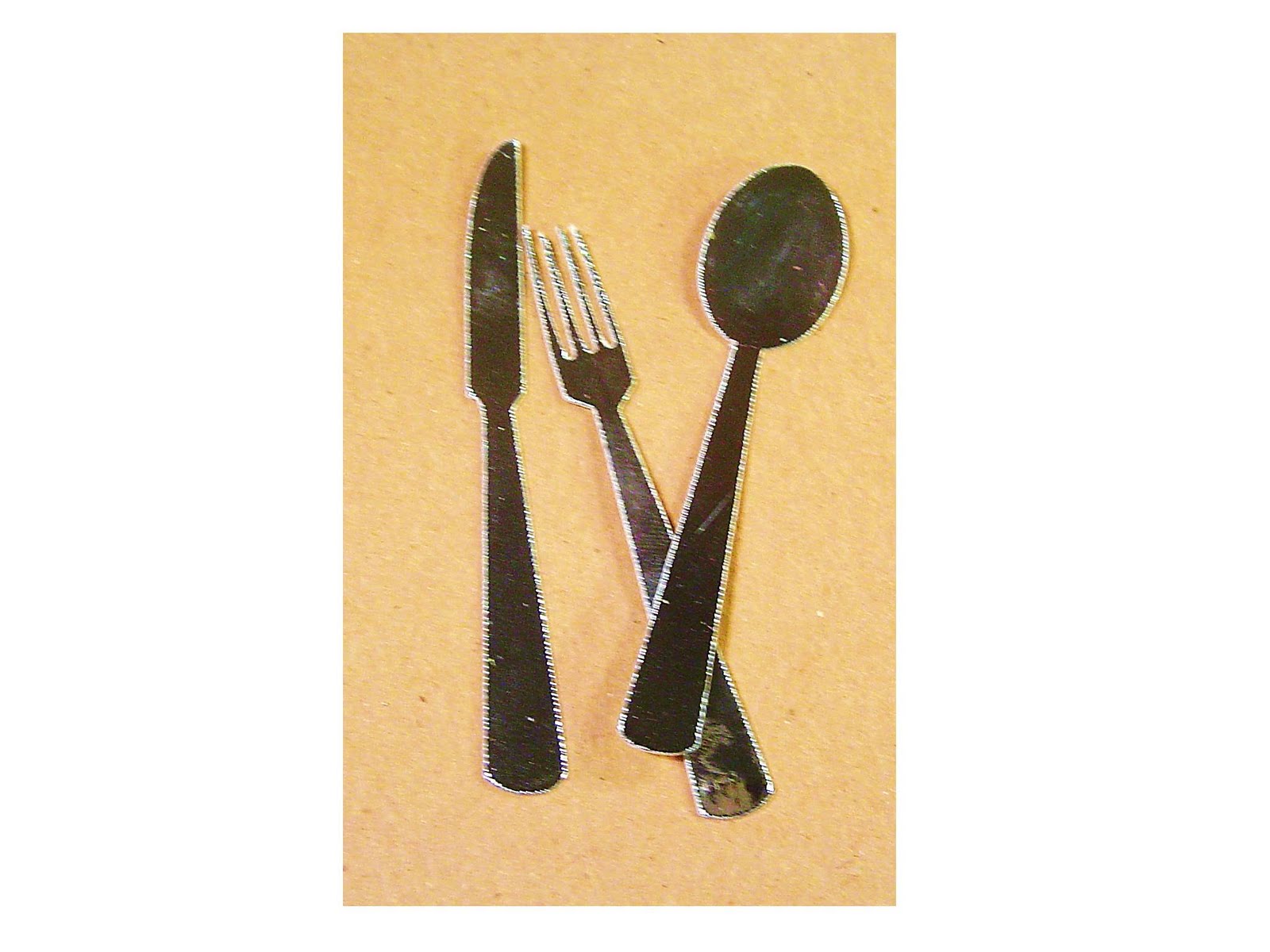
Paper Silverware


foil paper

I love this design. As you can see, the silverware can be cut very small. I used a ball stylus in a circular motion to give the spoon a little dip.

foil paper

These would be fun to use on a dinner party invitation or anything food related.
I can also see them with a diner motif. Picture red gingham.

Sunday, August 1, 2010

Work in Progress: The Common Things

"A thousand starlings beat the air with wounded wings.."
illustration: paper, ink


The Common Things

My husband Mark Horton wrote a song about us many years ago. This year I illustrated the song. As a continuing gift, (now months in the making), I am scanning the pages to produce a small book.

Using various patterned paper and my electronic cutter, I interpret his lyrics. The inking is done with a pigment ink pad, resulting in an aged look.


First draft illustration, paper, ink, netting, mini brads, text

The arm on the original illustration is articulated. Since each piece of cut paper is a design file, I have them to cut whenever I need them. This particular panel is designed with a future in a pop-up card, hence the movement consideration.

A labor of love.


Happy Anniversary, Mark


Saturday, July 31, 2010

Work in Progress: Star Ornament


Star Ornament

Star, prototype: glitter paper

Three dimensional designs continue to be a challenge to me. At first glance, these stars look alright, but inspection reveals many miscalculations. As this is true, gluing was strenuous - holding all the points together when they didn't really want to meet.


Star prototype, varnished glitter paper

This sample shows the addition of star cut-outs. Just like me to decorate before the design is correct. This piece is actually unfinished to give a clue as to how the design is accomplished.


star prototype: paper

Each point is one cut, folded and glued together.
The points then glue to each other to form the star.


star prototype: paper

The design works, but it is still wrong. I am over trying to make it right.
I have to put it away until I am brave and patient enough to take a crack at it again.

Thursday, July 29, 2010

Paper Dolls: Evelyn Tripp

Evelyn Tripp

Evelyn Tripp

Evelyn Tripp was a favorite model of the 1950’s and ‘60’s, due to her dramatic features and willowy stature. She was uncommonly beautiful and graceful, exemplifying the glamour of postwar American fashion.

The enchanting couture of the day could not have found a better muse than Evelyn Tripp. She appeared on over 40 magazine covers including Vogue and Harper’s Bazaar. Her sleek, structured frame and easy, classic style showcased the tailored lines typical of the era.

Evelyn was considered one of the most versatile models in the world of fashion. She was photographed by the best. Original prints of her image command top dollar today.

Evelyn's beauty is timeless. Her stunning profile, swanlike neck and doe eyes still mesmerize.


Evelyn Paper Dolls


varnished glitter paper, glitter


paper, glitter

These paper fashions are inspired by the lines of the day. They are mechanically cut, then hand detailed and embellished.


foiled paper, pink dresden, glitter, tulle, silk ribbon, foil buckle

foiled paper, glitter

Each set is unique. The doll and clothes are magnetic.


Thank You to Karen Eaton-Hinz and Jennifer Eaton, Evelyn's sister and niece, for encouraging the design of this paper doll and her expanding wardrobe.


Wednesday, July 28, 2010

Paper Dolls

Evelyn dress, paper, bronze dresden


PAPER DOLLS

I have made paper dolls since I can remember. These are the latest of my creations. Evelyn is after Evelyn Tripp, 1960's supermodel. More on her to come. I am currently working on a twin set for twin sisters - her twin sisters.

The dresses are on my workbench, in various stages. Below you can see the dress changes with various details. Aren't Sharpies wonderful? The new generation of fine line pens and markers are so accessible and I like the results. I carry one with me at all times.

Little Retro Girl


little retro girl, new design!


I am finding fans of my paper dolls in little girls. I thought I would design a doll that was more like them - rounder, shorter, littler. I wanted a set that had simple lines. The retro prints on the market are perfect for her itty bitty clothes. This first set will fit in a tin, pocket sized, and is magnetic.


little retro girl with clothes and sunglasses - glitter-fied


Evelyn's Wardrobe, sneak peek


Evelyn wardrobe, twin dresses

Evelyn wardrobe twin dresses for twin sisters

These dresses are made with glittered paper that is laminated or varnished. They have a medium sparkle and no mess. Some glitter papers will fill your world with much reflective debris. Glitter gets everywhere.

At this point, I am probably a certain percentage glitter, but you might not want to be. Whether testing for loose particles or checking the weight of the paper, I recommend touching the paper whenever possible.

Wednesday, July 21, 2010

TODAY'S FIND: Dresdens

Tiny red and pink dresden trim
Matte olive dresden trim
Red dresden, crimped


COLLAGE STUFF

www.collagestuff.com

A wonderful store with unique collage elements. Not only do they ship quickly but your order comes with a little favor pack of collage elements and wrapped in festive paper. It was a joy to open!


What is a Dresden?

A Dresden, or German scrap is a paper foil trim or ornament which is intricately embossed and die cut. Typical designs are stars, borders and flowers. The foil doily used in baking would qualify as a dresden. They are often seen in white, silver and gold. Gold being the most common.

Dresdens are useful to trim ornaments, boxes, cards and in doll house applications. I sought them for trimming my paper doll clothes and my tiny shoes. I was delighted to find paper trim in the scales and designs I wanted. The tiny is really, really tiny. (Yeah!) And the icing on the cake is that Collage Stuff has it in the yummiest colors. I chose pink, purple, matte olive, brown and red.

These beautiful trims are easy to use. They take glue well because of their stout paper stock.
They can be crimped to follow curves simply by pinching with your fingernails. Some larger trims can be cut down to fit the scale of a project.
The examples above are all trims. Individual motifs like birds or keys or moons are also available for a unique embellishment to paper craft.


Friday, May 8, 2009

Paper Puppets: Mermaid

Mermaid Puppet, paper, stencil board, mini brads, prismacolor, Sharpie marker


PAPER PUPPETS: Mermaid

Articulated paper figures have been called puppets, maquettes, pantins or dolls. I research, modify and perfect my designs to make them durable, movable and creative. I love to make things move. She has nice little wiggle in her middle.

Although I find this a very successful first attempt, I felt the neck was too short.

Mermaid Puppet, detail

The Mermaid.

The Mermaid is my original blank design cut from oiled stencil board and white cardstock. I cut each piece three times.
Once for the white card, twice for the stencil board.

The stencil board is glued together. When dry, it is finished with layer of white card stock, ready to be drawn upon. Once the layered pieces are dry, they are illustrated. Each part is hand-drawn with Prismacolor pencils and Sharpie markers.

The illustrated pieces are layed out and assembled, using tiny brads to form joints so that the puppets can move.

STENCIL BOARD

An old-fashioned board that is fortunately still made. It has changed little over time. Stencil Board is a material used by "old school" sign painters. It is meant to repel inks and paints. It is a card saturated with Linseed Oil and baked. Often three times.

It is a beautiful, durable, crisp board that is very thin and strong. It has a lovely, earthy, mottled complextion and when freshly ordered one can actually smell the Linseed Oil. Stencil board is not generally or popularly used in puppet making or paper arts, but it should be. It is so versatile if you know how to handle it.

I prefer it over chipboard because of it's sharpness and strength despite how thin it is. This is especially attractive to movable projects such as puppets.